
Custom fabrics give brands more freedom to create unique products—but they also come with challenges that are easy to overlook.
Over the years, we’ve found that many development delays and misunderstandings don’t happen during garment production. They start much earlier, at the fabric development stage.
Here are a few things every brand should keep in mind.
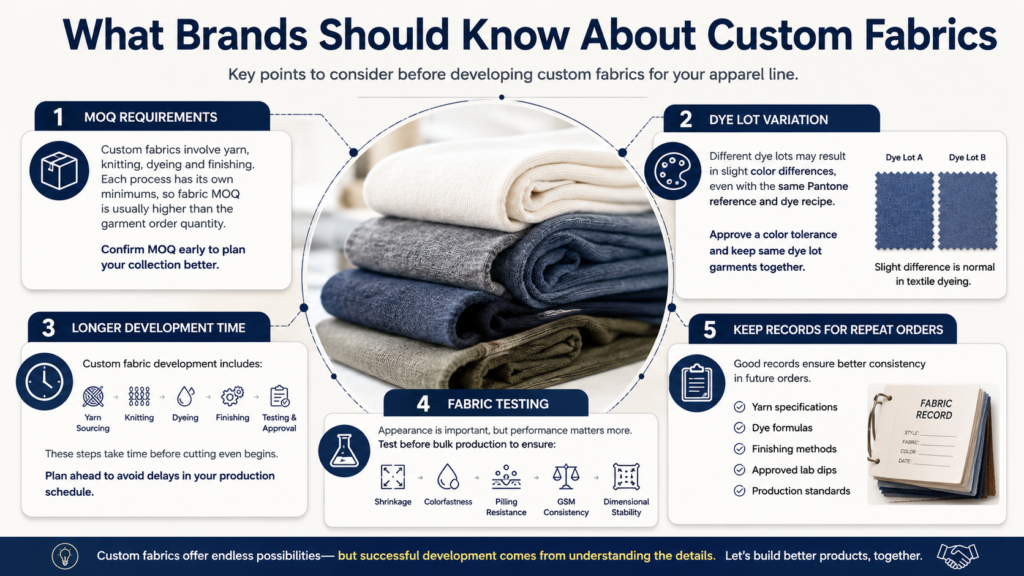
1. Custom Fabrics Have Their Own MOQ
Unlike stock fabrics, custom fabrics require yarn purchasing, knitting, dyeing and finishing.
Each process has its own minimum production quantity, so the fabric MOQ is often higher than the garment order quantity.
Confirming the MOQ at the beginning helps avoid redesigns or unexpected costs later.
2. The Same Color May Look Different Between Dye Lots
One question we hear frequently is:
“Why does the repeat order look slightly different from the first one?”
The answer is simple: fabric is dyed in batches.
Even when using the same Pantone reference, the same dye recipe and the same factory, slight color differences between dye lots are normal in textile production.
For brands with repeat orders, it’s always a good idea to approve a color tolerance and keep garments from the same dye lot together whenever possible.
3. Lead Time Starts Before Garment Production
Many people think the lead time starts when garment production begins.
In reality, custom fabric development often includes:
• Yarn sourcing
• Knitting
• Dyeing
• Finishing
• Fabric testing
• Lab dip approval
These steps can take several weeks before cutting even begins.
Planning enough time for fabric development helps reduce pressure later in the production schedule.
4. Don’t Skip Fabric Testing
A fabric may look and feel perfect, but appearance alone doesn’t guarantee performance.
Before bulk production, it’s important to verify properties such as:
- Shrinkage
- Colorfastness
- Pilling resistance
- Fabric weight (GSM)
- Dimensional stability
Testing early helps avoid quality issues after garments are produced.
5. Keep Records for Future Repeat Orders
Successful repeat orders depend on consistency.
Keeping detailed records of yarn specifications, dye formulas, finishing methods, approved lab dips and production standards makes future developments much smoother.
Good documentation is just as important as good manufacturing.
Custom fabric development isn’t simply about creating something unique.
It’s about balancing creativity, consistency, lead time and cost from the very beginning.
The more both brands and suppliers understand these details, the smoother the development process becomes.