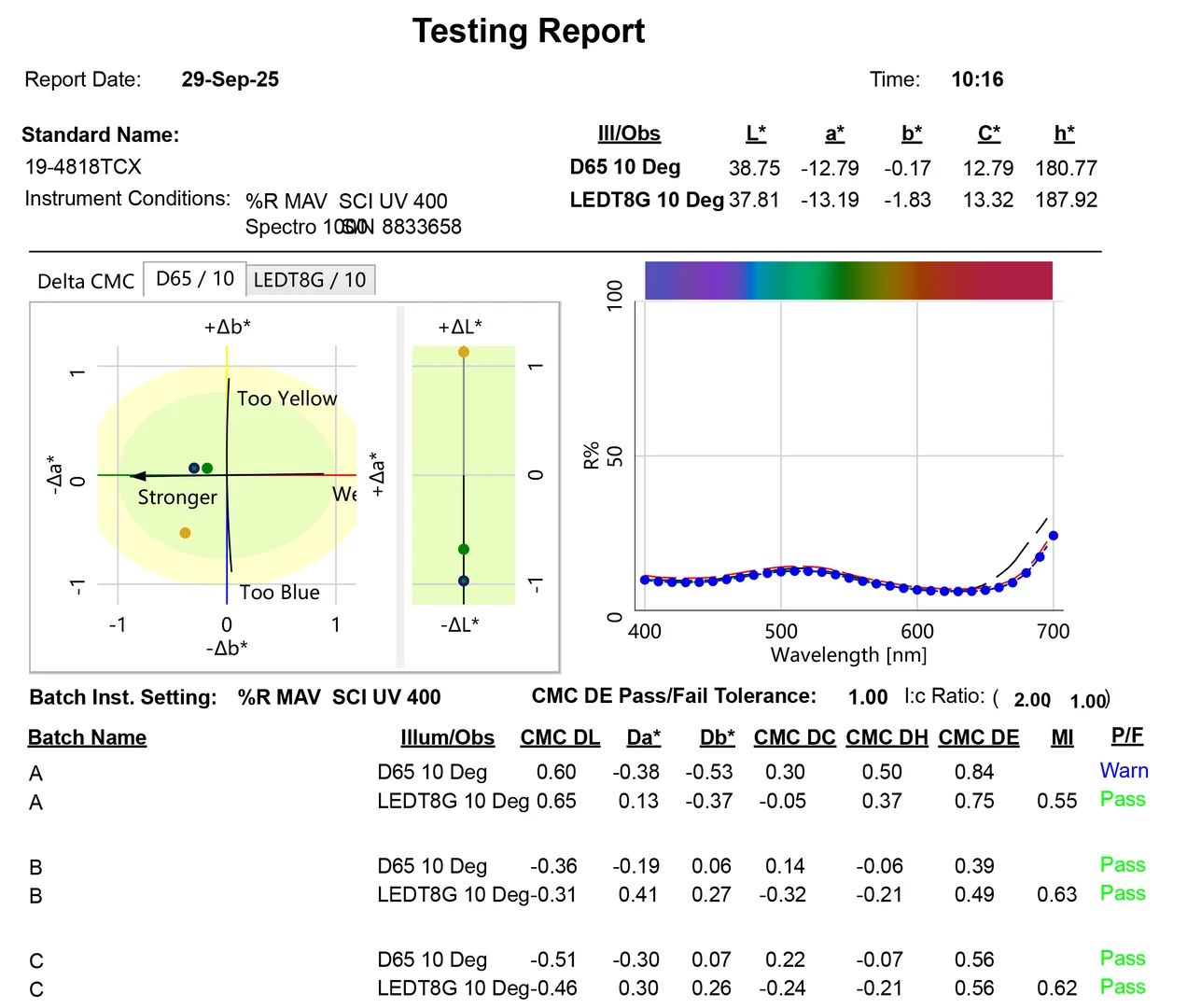
When working with overseas customers—especially big retailers and global brands (e.g., Walmart / Target / Costco)—color approvals are rarely based on “eye judgment” only.
Very often, customers require a CMC Color Reading Report (also called a Spectrophotometer Report) as part of the lab dip/shade submission package.
If you work in textiles, sourcing, or garment manufacturing, understanding this report is NOT optional—it can directly impact bulk production acceptance.
1) First Question to Confirm: Digital Evaluation or Visual Evaluation?
Before bulk or even during development, always clarify with the customer:
✅ Digital Evaluation (instrument-based approval)
or
✅ Visual Evaluation (eye judgement approval)
This is critical because:
If digital evaluation is the priority, mills will optimize recipes to meet the CMC numbers first.
In some cases, the shade can be CMC pass but visually different under certain lighting.
If the customer agrees to “digital first”, they should accept bulk goods when the data is within tolerance.
2) Request the QTX File for Higher Accuracy
If the customer approves by instrument reading, always ask for the QTX file (spectral data file).
Using QTX + physical standard + correct lighting direction helps dyers match shades much more precisely and improves “first submission pass rate”.
3) Key Values in the CMC Report (Quick Guide)
Here’s how to read the most common parameters:
DL = Lightness (shade depth)
➜ Positive = lighter than standard / Negative = darker than standard
Da = Red–Green axis
➜ Positive = redder / Negative = greener
Db = Yellow–Blue axis
➜ Positive = yellower / Negative = bluer
Dc = Chroma (saturation)
➜ Higher value = more pure / stronger chroma
DH = Hue difference
➜ Helps identify hue shifts under different light sources
DEcmc = Final pass/fail evaluation value
➜ The smaller, the better
Typical tolerance: ≤ 1.0
Strict brands: ≤ 0.8 (or tighter depending on the order)
4) Practical Tip (to avoid future disputes)
When placing orders to mills, always state clearly:
📌 CMC tolerance requirement (DEcmc limit)
📌 Evaluation method (digital vs visual)
📌 Light source / observer angle (D65 / TL84 / A, 10° / 2°)
This simple step can prevent many color disputes and costly re-dyeing.
hashtag#textiles hashtag#fabric hashtag#garmentmanufacturing hashtag#colorscience hashtag#qualitycontrol hashtag#supplychain hashtag#apparel hashtag#sourcing hashtag#labdip hashtag#colormatching hashtag#retail hashtag#walmart hashtag#target hashtag#CMC hashtag#spectrophotometer hashtag#datacolor