
In basic T-shirt development, neckline issues are often underestimated—but they are one of the most visible indicators of product quality. Recently, during our sample evaluation, we encountered a common but critical problem that many fashion start-ups face:
- The back neckline appears too loose and wide.
- The front neckline rides up toward the neck.
- The overall collar shape looks unbalanced and lacks structure.
In competitive apparel markets, details like this are often what differentiate a “basic product” from a “retail-ready product.” From a professional Quality Control (QC) perspective, this is not a single defect, but a combination of underlying technical factors.
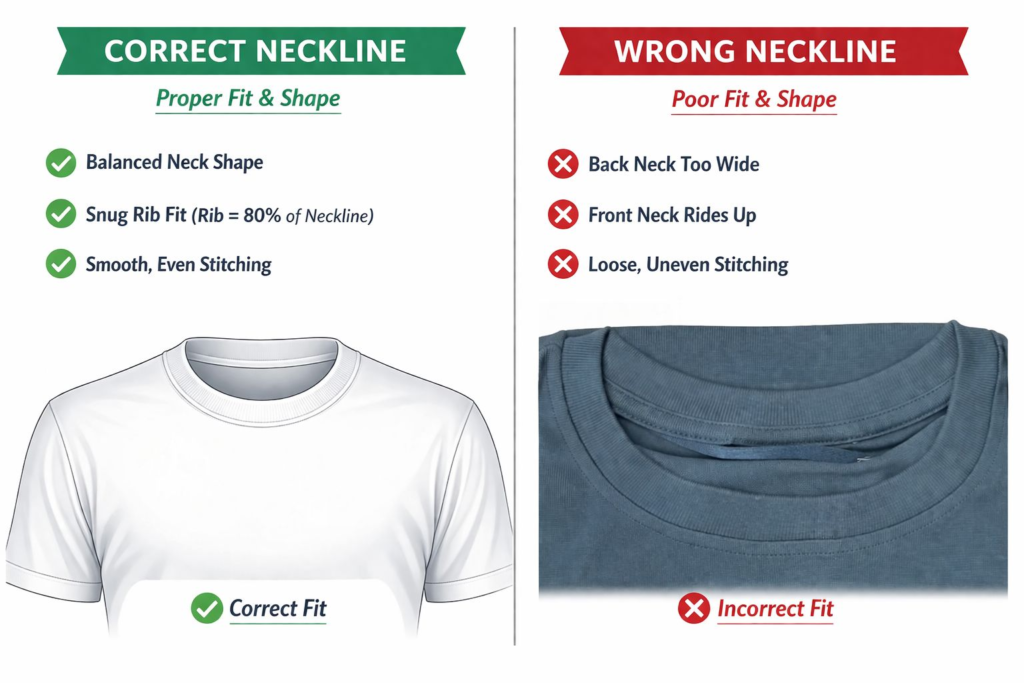
Critical Causes Behind T-Shirt Neckline Distortion
When a collar loses its shape, it usually comes down to three key technical root causes during the development and production stage:
Inconsistent Sewing Tension: Uneven fabric distribution during collar attachment often leads to localized stretching, resulting in distortion between the front and back neckline.
Pattern Imbalance: An inaccurate neckline curve—especially an overly extended back neck—can disrupt the front-back balance, causing discomfort and a poor fit.
Incorrect Rib Ratio: If the rib length is not properly reduced based on fabric elasticity (typically $75\%-85\%$ of the actual neckline circumference), the collar will lose recovery and appear stretched out, especially at the back.
Our Factory Improvement Actions for Perfect Collar Structure
To ensure our clients receive retail-quality garments that maintain their shape after multiple washes, we implement the following production standards:
- Rebalance the Neckline Pattern: Carefully adjust the back curve and refine the front drop during the pre-production sample stage.
- Recalculate Rib Ratios: Conduct stretch tests on every fabric batch to determine the exact mathematical rib-to-body ratio.
- Standardize Sewing Processes: Utilize strict 4-point alignment techniques and controlled tension during collar attachment.
- Add Back Neck Tape: Implement internal shoulder-to-shoulder or back neck taping for enhanced structure and long-term durability.
- Control Finishing Processes: Monitor pressing and ironing stages to avoid over-stretching the collar area before packing.
Contact our sourcing team to discuss your project.https://arenalab.cn/contact/