
When working with overseas apparel customers—especially big retailers and global brands—color approvals are rarely based on “eye judgment” only. Very often, customers require a CMC Color Reading Report (also called a Spectrophotometer Report) as part of the lab dip or shade submission package.
If you work in textiles, sourcing, or garment manufacturing, understanding this digital color data is not optional. It is a critical skill that directly impacts whether your bulk fabric production is accepted or rejected.
1. Digital Evaluation vs. Visual Evaluation: Which Comes First?
Before jumping into bulk production or even during the initial development stage, you must always clarify one essential rule with your customer:
- Digital Evaluation: Instrument-based approval using data.
- Visual Evaluation: Human eye judgment using a light box.
This distinction is critical. If digital evaluation is the priority, dye mills will optimize their chemical recipes to meet the CMC numbers first. However, in some cases, a fabric shade can be a “CMC Pass” mathematically but look visually different under certain lighting. If the customer agrees to a “digital first” workflow, they should legally accept bulk goods when the spectrophotometer data falls within the agreed tolerance.
2. Why You Should Always Request the QTX File
If your customer approves lab dips by instrument reading, don’t just ask for a PDF. Always ask for the QTX file (the raw spectral data file).
Using the digital QTX file combined with the physical fabric standard and the correct lighting direction allows dye house technicians to match shades much more precisely. This technical shortcut significantly improves your “first submission pass rate,” saving weeks of back-and-forth couriers.
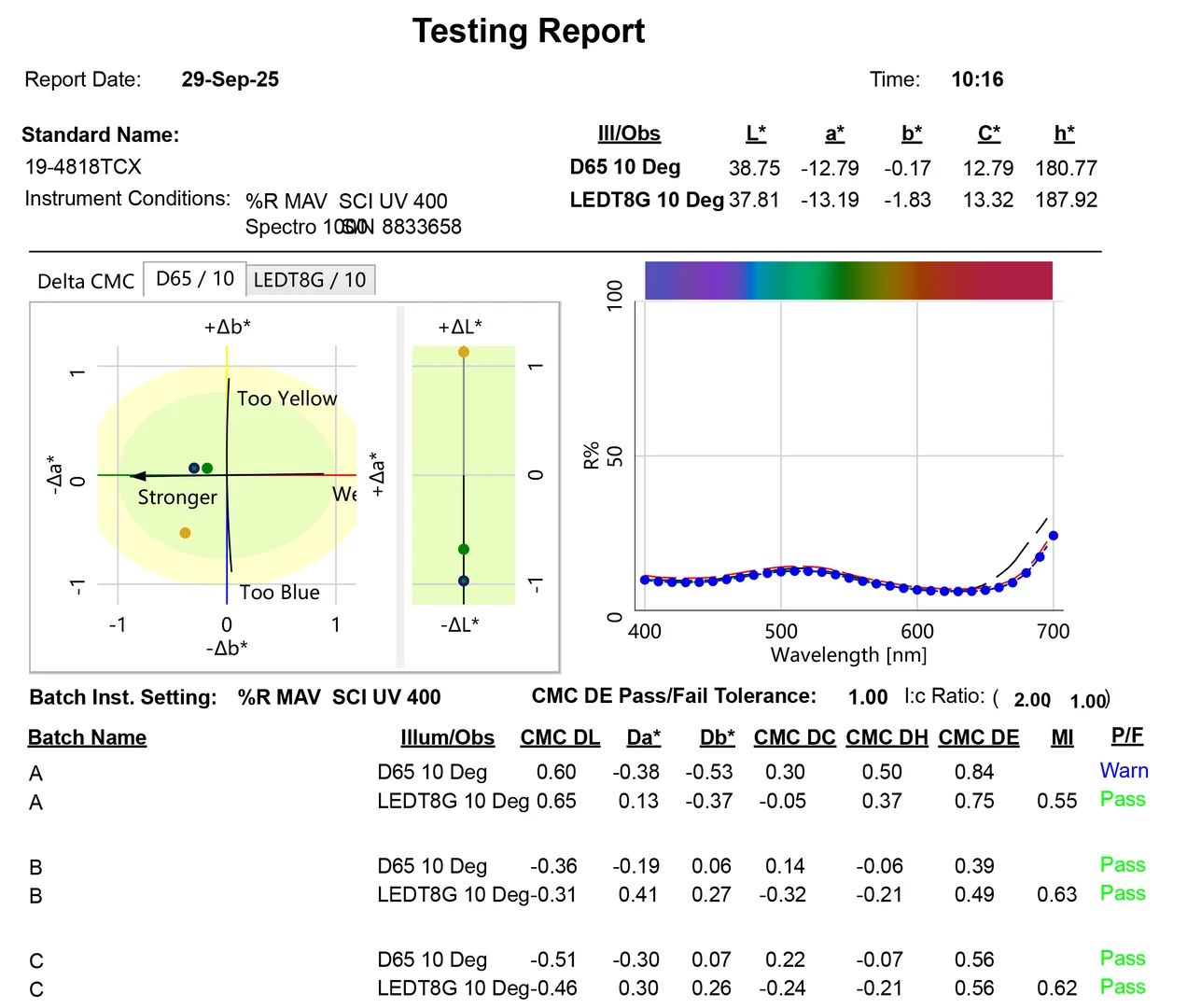
3. How to Read Key Values in a CMC Spectrophotometer Report
Here is a quick technical guide to interpreting the most common parameters found on a standard DataColor or X-Rite CMC report:
- $\Delta L$ (Lightness / Shade Depth): Positive (+) means lighter than standard; Negative (-) means darker than standard.
- $\Delta a$ (Red–Green Axis): Positive (+) means redder; Negative (-) means greener.
- $\Delta b$ (Yellow–Blue Axis): Positive (+) means yellower; Negative (-) means bluer.
- $\Delta c$ (Chroma / Saturation): Higher values mean a more pure, stronger chroma.
- $\Delta H$ (Hue Difference): Helps identify hue shifts under different light sources.
- $\Delta E_{cmc}$ (Final Pass/Fail Value): The total color difference. The smaller the number, the closer to the target. A typical commercial tolerance is $\le 1.0$, while strict brands require $\le 0.8$.
4.Practical Contract Tips to Prevent Costly Color Disputes
When placing fabric orders with textile mills, verbal agreements are never enough. To avoid future claims and costly re-dyeing, always state these three parameters clearly in your purchasing contract:
- The exact CMC tolerance requirement ($\Delta E_{cmc}$ limit).
- The primary evaluation method (Digital vs. Visual).
- The required primary light source and observer angle (e.g., D65 / TL84 / A, 10° / 2°).
Partnering with a Supplier That Understands Technical Quality
Managing high-end textile color approval requires technical discipline, but it shouldn’t require massive volume.
At our manufacturing facility, we specialize in helping emerging and independent clothing brands navigate these exact technical challenges. We offer flexible MOQs so that growing labels can access the same level of rigorous lab testing, spectrophotometer reporting, and premium quality control that global retailers use, without the burden of high inventory risk.
Need help setting up your fabric quality standards? Contact our team today to review your upcoming production color specs.